OPINION

THE HOUSE OF WINDSOR

Catherine’s September Message and Her Video,

the “Midsummer Night’s Dream” in Norfolk

Late notes on the margins

By Elena Vassilieva
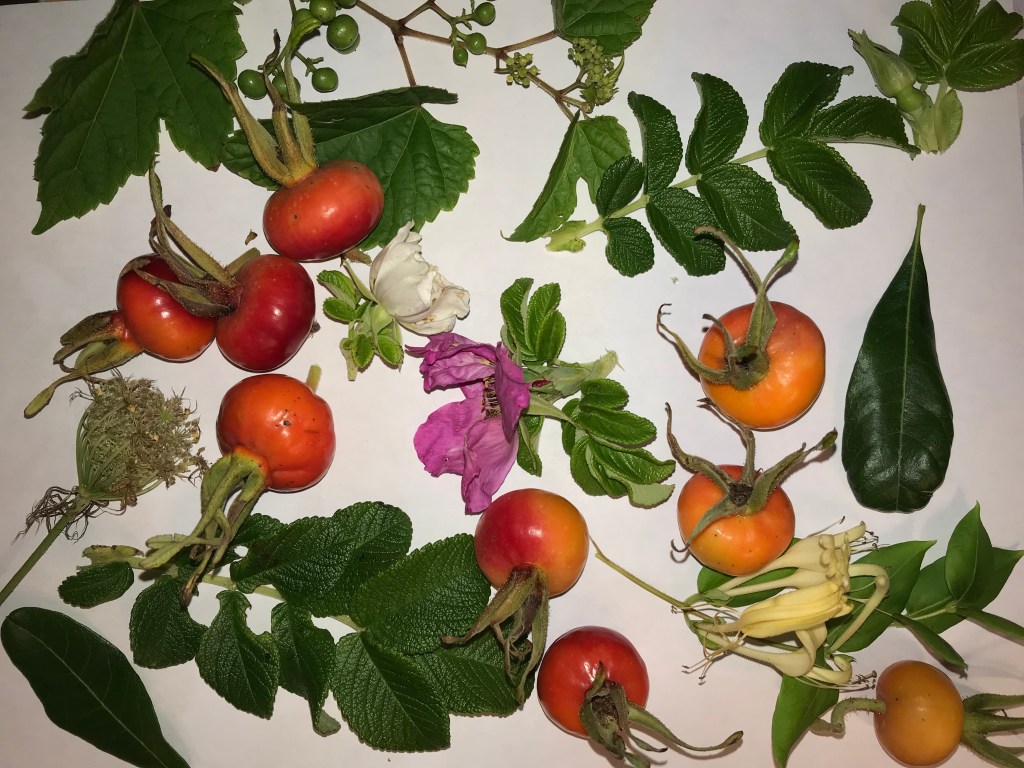
The Midsummer Night’s Love Potion Ingredients. Words and image by Elena Vassilieva

On Monday, September 9, 2024, at tea time, Greenwich Mean Time, Catherine, the earnest wife of Windsor, sent a long-awaited message to the world. Although her supporters had the pleasure of seeing her at Wimbledon this past summer, they didn’t think they would hear from her again that soon. On July 14, 2024, to everyone’s delight, she radiated joy and freshness, smiling and waving to the Wimbledon crowd which in turn greeted her with standing ovations. Her purple tailored dress flattered her sporty figure, and she seemed to have gained weight, but that was only to her advantage. Her long chestnut locks framed her tanned face in her usual fashion. So, when, in September, her lengthy message arrived, it was expected that she would be as fit as in July, and she didn’t disappoint.

Catherine’s recent message on Twitter/X was accompanied by a three-minute video which came as a great surprise and, to some, as a bit of a shock. The good news was: she had just finished her chemotherapy and from now on planned to stay focused on being cancer-free. It was not quite clear whether she got rid of cancer altogether. But the ambiguity around it had been there from the very start. In March, she announced in her first video that she had cancer, yet, the chemotherapy was preventive, she said. Now, in most languages, the word ‘preventive’ is used in the context when something dangerous is still not there, but there is a risk that it might come unless some preventive measures are taken. So, let’s hope that was exactly the case.

Her March video message was filmed in the sunny garden at their Windsor home. She was sitting there alone, on the bench, with chirping birds and blooming flowers in the background. Life in her garden went on as usual, according to the rhythm of springtime. Her pale and makeup-free face betrayed wistfulness, and her casual striped jumper signaled to the viewer that she cared little how she looked and that more serious things were on her mind. The March video struck and saddened everyone. I don’t think there was a single soul who was left untouched. Many thought, myself included, that delivering the sorrowful news directly and by herself was very brave, let alone unprecedented. However, I wondered why she would do that, what for? She could have just followed the usual Royal, ‘never complain, never explain,’ tradition, and that would’ve given her more air to breathe and made her less anxious. The video announcement must have added even more stress to already a very stressful situation, especially because she makes an impression of being an introvert, who is a rather shy public speaker.

The decision to disclose her malady this untypical for the Royal Family way was very likely dictated by her PR team, who may have believed that this tactical move would be an appropriate antidote to the insanity of some vicious cliques on social media, who kept themselves busy circulating falsehoods. Alas, it didn’t stop all the fantastical theories about her which continued to trend on Twitter/X. Therefore, it was her PR team’s huge miscalculation, in my view. They should have known better, but, alas, it seemed like the biblical wisdom, “Answer not a fool according to his folly, lest you be like him yourself,” had escaped their minds completely at that particular moment. Another peculiarity was that she didn’t say what type of cancer she had, while mentioning her preventive chemotherapy treatment. Privacy is everyone’s right, of course, and she stood her ground.

I assumed then, she would give a more detailed account of what has happened to her after she will have finished her treatment, otherwise her disclosure about the illness would make no sense at all, not on a large scale, anyway, other than to satisfy public curiosity about her whereabouts for one minute and to give the bloodthirsty hyenas on social media more food for speculation and fabrication, which should be of no importance to her at all. But having a social media platform with millions of followers from around the globe, and since this, however agonizing, circumstance presented itself, she shouldn’t shy away from it, as this is about the most significant and far-reaching public service she could ever do. Her first-hand experience and her insights would be invaluable to all other sufferers who look for hope and moral support.

Considering this, even her main project about the importance of early years of childhood appears to be rather redundant, especially if one takes into account the material side of her own personal circumstances. Growing up in a sufficiently well-off middle-class family, and, unlike Princess Diana, not working a day in a kindergarten or any other child care facility, and marrying into one of the most prominent families on Earth who can afford a nanny or two and who can invest into their children par excellence, all this makes her very poorly qualified for propagating the idea of a happy childhood for every child. In its hypocrisy, it is malodorous at best and no more than a hollow sound whose only purpose is a glossy presentation. Had she run an experimental school for poor children, the way Count Leo Tolstoy did for all the peasant children on his estate at Yasnaya Polyana, for instance, where she, like Count Tolstoy, would implement all her ideas about happy childhood, it would be different and it would be more than just words. Right now, her project might resonate with the upper echelons of the middle class and well-to-do aristocracy, who traditionally send their children to boarding schools and not rarely leave their offspring scarred for life with this, just read Earl Spencer’s recent memoirs about his harrowing childhood experience. However, ordinary people wouldn’t buy into a single word of the emptiness of her message unless it is solidly grounded. Shortly after she launched her campaign on January 30, 2023, at the BAFTA, in London, she published her op-ed article on the subject in the Financial Times, in March of 2023. I had to read it at least three times in order to fully comprehend the message, and I was still left guessing what it was all about.

Despite the good news that her chemotherapy dark days are behind her, Catherine’s message didn’t contain a single word as for what type of cancer she was fighting and what remedies she used. It must have been very disappointing to all the cancer fighters who have been following her and who have hoped to hear something more concrete for themselves than just the abstract “to love and being loved” and “I remain with you, side by side, hand in hand. Out of darkness, can come light, so let that light shine bright.” Although doubtless good words, those are not enough to win the battle. After people had watched the video, bewilderment was added to their disappointment. With the accent of the pU(r)fect pU(r)son (perfect person), she read her message with care and labor of the Matron of Great Britain, as if her only mission had been to dress all the words into her posh-accented pronunciation, as if it mattered much to cancer sufferers. While she read it, a pleasant music was playing in the background, and one was offered a rare glimpse into an absolute euphoria of the Waleses’ private life in the countryside, or shall I rather say, an idyll? Their jolly children provided the loveliness of the captured moments, but, oddly enough, they weren’t the pièce de résistance. The camera focused on Catherine instead. As if she hadn’t been going through the hardship all this time, she appeared in the movie as a fresh-looking and dazzling star, with her ever infectious laughter and her gorgeous hair flowing in the wind. If only everyone came out of the woods, I dare use her own words, as rejuvenated as she did.

The euphoria that may have overpowered her after, I assume, a successful treatment and nine strenuous and hardest months of her life, is perfectly understandable and justifiable, but nevertheless if one views it in the context of her job as a princess whose main and primary purpose is public service and whose husband’s motto, Ich dien, implies the same meaning, the movie is somewhat bold and transgressive, given all the intimacies thrown into the public eye. And, à propos, the Prince of Wales’ Ich dien should also be considered in the context of the Royal hierarchy, which goes as following in this case: Their Majesties the King and the Queen Consort (thank goodness, they didn’t take part in the movie, either turning down the roles or not being invited), the state and the public, and only then his immediate family and his in-laws who played an important role in the film and, undoubtedly, in the process of Catherine’s healing. Only Uncle Gary, крикун и хвастун, was missing there, at the game table. The in-laws have no formal role as such within the hierarchy of the Royal Family, unlike his wife, with whom the Prince shares his public service and duties.

By no means, Their Royal Highnesses are obligated by their official duties to open the curtains and make the set of their private life bare, and there is no need in it, in fact, not even when illness strikes. Not for fear of losing the Royal mystique, as some would argue, not at all, but for the simple reason of showing poor manners and being inconsiderate. After all, there are so many out there who also suffer from the same illness, but can’t afford the same care, and, very often, have to be waitlisted. Aside to this sensitive issue, isn’t it deemed rather disrespectful and even rude towards their supporters and well-wishers to display their affection for each other in public in such a way that they appear rather exhibitionistic, making, in turn, their viewers almost voyeuristic? No, no, no, Your Royal Highnesses, we do not need your invitation to your private party, thank you very much. Enjoy yourselves, but please be kind, do not involve us!

I also felt quite sorry for all the Prince of Wales’ admirers who had always flirted with him, that is, with his images on social media. I doubt very much that his fans felt particularly good about seeing their beloved prince in such intimate, nearly erotic, scenes, even if he was there with his wife. The Prince of Wales has been playfully, with lots of affectionate emojis, regarded as ‘handsome’, ‘cute’, ‘adorable’, ‘hot’, ‘sexy,’ etc., in the comments on social media. Of course, he wouldn’t know about it and he wouldn’t care about it, but his PR team would and should. How on earth would they not warn him that it’s not princely, but ungentleman-like to offer something like that to his admirers? Not noble at all and rather cruel, I’d say, neither Princess Diana’s boy nor His Majesty the King’s, but whose then? Mrs. Middleton’s, perhaps? It is being often reported how dearly she has ‘mothered’ him throughout the years (for more details see Robert Jobson and Richard Eden). And why wouldn’t Catherine herself think about his fans, and hers as well, especially when she is using the words ‘with humility’? What does she think humility is? Making their well-wishers jealous and even belittled? Or was she trying to tell her husband’s fans that they’d better not forget that he is a married man before they allow themselves such an impossible frivolity on social media? But who would take their perfectly harmless and lighthearted flirting with their own imagination seriously? I bet not even they themselves, yet, the Prince must have hurt their feelings considerably, shutting down their imagination but also love for him, because Love goes hand in hand with imagination, remember?  

Isn’t it in the Royal Family’s best interest to keep their private life well-hidden from their fans, in order not to irritate or hurt them? And the monarchy needs its supporters quite badly, more, in fact, than Royal movies filled with distasteful bourgeois intimacies. I didn’t think there was a threat, other than the illness, to the Waleses’ marriage, did you? And if there were, what might it be? Who would dare to break into the golden cage that is under seven locks? Hardly anyone, unless it is Love, of course, as l’amour force toutes les serrures. Or would either of them dare to escape from the golden cage? I don’t know about Catherine, but I think this Prince of Wales wouldn’t even contemplate the nonsensical idea, as the former ones did dare to break free from the cage, but they didn’t fare very well afterwards. Or is the situation, despite Catherine’s healthy appearance, this dire that they have to hire William Warr to document their relationship for posterity? But, happy with the results, on a whim, they decide to let the public see the film now, so that everyone would sigh and say, weeping: “Oh, poor things, oh, poor sweethearts, how much in love they are! Twenty (more or less?) years together, and they are still such lovebirds, as if they were just married”? Releasing the video now, instead of fifty years later, they did quite a disservice to themselves. Today, it just doesn’t feel authentic and, above all, doesn’t make much sense. One can’t stop wondering: what was the reason for staging it all? Why? Maybe they found inspiration in Shakespeare’s “A Midsummer Night’s Dream?” Others on social media thought whoever directed the film had watched quite a bit of “The Gladiator” and “The Twilight Saga.” I haven’t seen those, so I can’t comment on the accuracy of their intertextual relationship. 

But it doesn’t matter who or what inspired them, because what matters more is modesty which seems more and more to be missing from the arsenal of virtues and values of this princess. Or maybe she just let all the Royal restraints go away and let the public see her casual Kate Middleton’s side, again? And why not, one cynical voice would say, she is human, after all, isn’t she? Everyone does it, you do it, too, even if only occasionally, don’t be such an insufferable prude, it’s the age of selfies and ‘me-me-mes,’ even in the Royal circles, and sexiness sells better than primness, don’t tell me, you don’t know that. The Royals are free to do whatever they please, especially when the Queen Elizabeth II’s time with her moral compass seems to be an era long gone. Hardly convincing an argument, I would say, because that’s the opposite of what is expected from the Royal Family as guardians of traditional values. They aren’t supposed to follow trends of any kind. How about creating trends? And that depends on the trends.  

It is Catherine’s phrase ‘with humility’ that is particularly bothersome, because this Norfolkian idyll and Kate Middleton’s euphoria do come across as a slap in the face for all those who are still going through hell and maybe aren’t seeing the light at the end of the tunnel. Modesty, humility, and kind reservation would’ve been more appropriate than the flowing hair that evoked an herbal essence shampoo advertisement in some viewers, let alone the laughing-their-heads-off scene in the movie, the very scene that boldly adorns Their Royal Highnesses’ Twitter/X account now. And I wish I didn’t see that clumsiness in the scene where the Prince of Wales is, in a sort of religious ritual, finding himself on his knees and kissing his wife, as it appears, on the neck (!), with their confused children sitting around. Those are especially tone-deaf and incongruous with the circumstances, but also aesthetically not very eye-pleasing scenes, as this kind of romantic scenery is traditionally reserved for a certain age, say, Romeo and Juliet’s age, shall one wish to go public.

The best thing they could do was making their children the focal point, as they both seem to excel as parents. They would let the viewers feel the love through their children while showing us how much they enjoy parenthood. Had they done it, I would’ve been the first to admire and praise them immensely. To other parents, their parental experience is of greater interest than their intimacy, as there is nothing trickier than to rear a child in these difficult times, whereas the quasi-erotic desire filmed in the dunes is not only superfluous, but also very immodest and, frankly, quite laughable. Love, if it lives in a family or between two people, doesn’t have to be on display at all, as Love can be seen and heard and felt without it. But if it’s not there, nothing, not even a midsummer night’s love potion, and definitely not a movie that advertises a certain lifestyle, would bring it back for one. Had they posted their video on their private social media account, however, I would’ve just said: “Wonderful news! Congratulations to Catherine on completing her treatment successfully! What a cute movie! Great and audacious (!) acting in front of the camera! It’s a true idyll, isn’t it?!” And as a postscriptum I would add: “Hmm, apparently the matrimonial idylls exist in this world, and I thought that all marriages happen in Heaven. In Heaven only.”

Written on September 24, 2024 in the Sky Control Room, on Little Harbor, on Cape Cod.

Copyright © 2024 by Elena Vassilieva. All Rights Reserved.
OPINION

THE HOUSE OF WINDSOR

Camilla’s Coronation Quiche, Catherine’s Headpiece, the Princess Diana’s Shadow, the Coronation Rain, and No Tiaras

The post-Coronation notes on the margins

By Elena Vassilieva

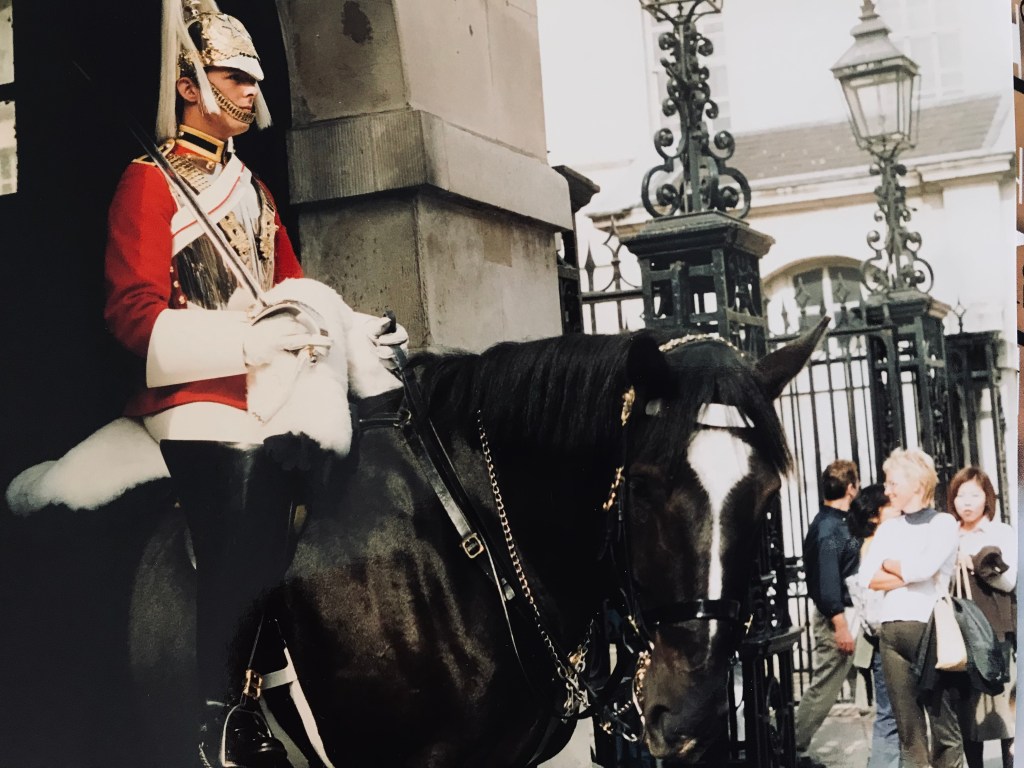
“Honores mutant mores.” – The Queen’s Life Guard. Photo by Elena Vassilieva.

“And fragrant oils with ceremony meet…” – John Keats, Lamia (1820)

Rainy days are made for lovers, of course, but evidently also for the British kings and queens on their Coronation days. It rained on the day of the Coronation of Her Majesty The Queen Elizabeth II on June 2, 1953, but judging by the photos and the film, the rain didn’t seem to matter at all. On the contrary, it added a very romantic touch of tenderness and love to the event. The 27-year-old Queen, escorted by her husband, Prince Philip, was smiling and waving inside the Gold State Coach, and people were joyously greeting them on the streets. Inside Westminster Abbey, somehow, it was arranged for eight thousand guests to be seated. The partakers were clad in their ceremonial robes and fur mantles, also wearing hats and diamonds. Despite the “heavy smell of mothballs,” as Lady Glenconner, one of the six maids of honour, recalls, the reigning air of this highly religious ancient ceremony was similar to that of the theatrical spectacle. The young Queen dazzled the world with her innocence and beauty, generously, yet, very tastefully, bejeweled with all the historical articles once worn by her predecessors, for the sake of tradition, but also for good luck. It was the day and the rare occasion for the unbounded Royal splendour.

But then there was also the moment, when she was sitting in that ancient Coronation chair, still without the crown on her head, but with the most innocent look on her face that betrayed her fear. That moment will stay forever with many who watched the Coronation. One could feel the Queen’s sincere desire to be a committed and selfless servant of God and her Queendom. It was the turning point in her life, the Rubicon, from where there was no way to look or to go back at all. It’s the destiny of the strong, not of the weak, and she knew it, despite her young age. There haven’t been many of those who were to be crowned and who would be defeated by their own weakness and turn back. Most recently, only the King Edward VIII, who abdicated in 1936, without ever being crowned. At that instant, one could also see the young Queen’s fearful anticipation of the future, as at that crucial moment in her life, she entrusted herself, before God and her subjects, with the duty of being at their disposal as long as she lived, of placing the needs of others always before her own. Of course, she was an ideal and natural fit for this very honourable but also burdensome role, displaying these qualities already as a child. After cooking with her friends, during the war years at Windsor Castle, nobody wanted to clean dirty dishes, writes in her Diary the Queen’s childhood friend, Alathea Fitzalan Howard, but the then Princess Elizabeth seemed to enjoy it, always volunteering to do all the dirty work. It must have been the joy of being conscientious, responsible, and in charge, without shying away from thankless chore, but setting a good example for others to follow instead. And so she stayed this way throughout her whole life, leaving the Crown, I thought, in safe hands.

The Royal Guessing Game of ‘to Invite or Not to Invite,’ and the Coronation Rain of 2023

Prince William crossed his fingers, pleading for no rain on the day of the Coronation, when he and his wife were greeting the well-wishers on the Mall the day before. But, alas, on Saturday, May 6, 2023, the rain didn’t fail to embrace the King and his subjects, only confirming that the weather caprices are now part of the Royal tradition. Despite it, the well-rehearsed coronation procession to Westminster Abbey exuded high spirits and was warmly welcomed by the gathered crowd on the streets. Many had been camping on the Mall for days, guarding the space to have the best view on the day of the event. The Abbey was filled with more than two thousand guests, nearly four times less than in 1953, due to husbandry of the ‘slimming down’ monarchy. To invite or not to invite had become quite a Hamletian conundrum for the King, causing His Majesty a head-splitting migraine, a controversy in the media, and probably a huge disappointment for many. Thus, the King didn’t send an invite to even not very distant blood relatives, his own goddaughter, India Hicks, who was a bridesmaid at his and Princess Diana’s wedding in 1981, and Ms Hicks’ 93-year-old mother, Lady Pamela Hicks, the late Queen’s cousin and friend, and the daughter of the Lord Mountbatten. On Instagram, Ms Hicks shared that “The King was sending his great love and apologies, he was offending many family and friends with the reduced list. [I]nvitations to the coronation were being sent based on meritocracy, not aristocracy.” Lady Pamela said that she wasn’t offended at all, in fact, she was “pleased to see this change.” But I thought such an unexpected turn of events very sad and harsh, after all, the Coronation is also a family affair, almost like marriage, and to exclude blood relations, especially those who played a significant role in the lives of the King’s parents, is incomprehensible, let alone a very regrettable personal act.

The Coronation invitation appeared on the Royal Family’s website on April 4, 2023. The heraldic artist and manuscript illuminator, Andrew Jamieson, was chosen to design and paint it, and he performed the task splendidly, highlighting the King’s humour and love of the countryside. The cheerful card was much to the liking of both the public and the environment-friendly and eco-conscious King, who is said to talk regularly to the flowers in his garden. The unostentatious and jolly design of the invitation was then reproduced and printed on recycled paper. But there was one thing to meet the eye on the card that neither the mischievous unicorn and the lion, nor the Green man, nor the pretty cornflowers and the roses could possibly make one miss it. There the King’s wife was styled as Queen Camilla, instead of Camilla, the Queen Consort, as she had been officially known in the recent months. The waves of surprise, bewilderment, and even indignation crashed onto Twitter. Who would have thought that the King would disobey the wishes of his late mother that soon and make the change? Even the title of the Queen Consort was only tepidly supported by the public when the official announcement was made by the Royal Family on February 6, 2022. The Queen’s gracious move to bestow the honourable title of the Queen Consort on the then Duchess of Cornwall had taken off guard quite many Royal followers, myself included.

But after pondering over it, I found the Queen’s decision fair. The then Duchess of Cornwall had been escorting her husband to so many engagements of his, in addition to promoting cultural, educational, and social values on her own, with a special focus on literacy, books, dance, theater, and domestic abuse of women. In spite of these successful endeavours of hers, I didn’t expect that the title of the Queen Consort would be changed to that of Her Majesty the Queen Camilla that soon after Her late Majesty’s death. It seemed the King was in a rush to drop the word ‘Consort’ from the given title, and one can comprehend his feminist logic. After all, his wife has been his faithful companion and partner for so many years, therefore the wish to appreciate her efforts and make her officially his equal is only natural, and his actions are perfectly justifiable. However, the matter isn’t entirely uncontentious and should have been handled with greater care and tact. First of all, the late Queen’s last word differed a great deal from what had been decided lately, and it can be perceived as a disrespectful act towards Her late Majesty and even towards the King’s subjects.

Secondly, the King was once married to Diana, the Princess of Wales, with whom he has two sons. Hence, it’s rather insensitive towards the Princes to bestow Camilla with the title of the Queen. The Princes conceded once already, when their father made a decision to marry their mother’s rival. According to Prince Harry, it felt like an utter blow. Clearly, both women aren’t in competition any longer, and the convoluted love triangle isn’t something we should be discussing here, nonetheless, Princess Diana’s persona should have been given more love and kindness, out of respect for her, her sons, and for all her admirers. Even more so, because the love triangle was resolved to Camilla’s advantage. Here, on Earth, she is the winner. It’s no secret that Princess Diana’s feelings for the King were intense and deep, but unrequited towards the end of their relationship, and that alone is the reason why the King should have acknowledged his first wife. Also, it’s a pity that the King seemed to have consigned to oblivion the fact how much in awe and in love with the Princess he was once, even if he eventually found Diana unbearably hard to please. To reprove him for the latter would be unwise, as Princess Diana was an extraordinary and rare woman, strong and numinous. It’s hard to imagine anyone who would match her and who would be her equal. Little wonder that her persona invites a metaphorical way of speaking about her. She could easily be compared to a divine woman, a goddess, who came to Earth by pure chance, for a short visit only, but, unable to find her true love and happiness here, dismayed by the cruelties of this world, had to leave this place way too soon, rising above the calamities and unfairness of mankind, up to the stars.  

But the most disappointing thing, in my opinion, is that Camilla herself hadn’t objected to the elevation of her title. I thought it was out of character. But maybe I was mistaken all this time, overrating her sensibilities and moral proprieties? Last summer, while reading Robert Lacey’s Battle of Brothers, I found one particular remark about Camilla rather unsettling. He maintained that, “[a]ccording to Stuart Higgins, a royal correspondent in the 1980s and later editor of the Sun, Camilla Parker Bowles provided him with regular off-the-record briefings about the state of the royal marriage from 1982 to 1992.” Reluctant to believe it, I put the remark aside in my mind, but now, I fear, it might be true. Why couldn’t Camilla have refused the title out of consideration for Diana, just as she did in the past with the Princess-of-Wales title? All this time, Camilla seemed to be uninterested in the Royal regalia at all, all she wanted was the love of her husband, and that’s what made the couple not only romantic and adorable, but also quite inspiring in affairs of matrimony. Their mutual fondness made people forgive them the unpleasant intricacies of their love triangle in the old days. In addition to her hairdo, Camilla’s (seeming?) humbleness and lack of the apparent ambition to be in the limelight were her most powerful weapon. She also seems to know the boundaries and how to position herself physically in public, so that the view of the King remains unobstructed. And she’s been doing it effortlessly, projecting an image of the down-to-earth, unaffected, contented, and self-assured woman. I admired that attitude of hers, so, upon the title change, it felt as if my perception of her public persona hadn’t been entirely accurate. By no means, it’s a good feeling.

On Camilla’s Inclusiveness

The King’s wife’s widely praised inclusiveness should have been questioned and revised by Camilla herself more often than not, because ultimately any unrestrained inclusiveness just backfires. Think of the Lady Susan Hussey affair at Buckingham Palace, at the end of 2022. The woeful incident on November 29, 2022 could have been easily avoided, had Camilla been more selective as for whom to invite to the party. Less would’ve been obviously more. The place was swarming with just too many guests, there was no room to swing a cat. One can only imagine what ran through Lady Susan’s mind when the whole absurdity of the situation erupted. She had provided the monarchy with 60 years of loyal service. Yet, her tireless volunteer work had been unjustly questioned, after the unscrupulous Londoner opportunist, Ms Ngozi Fulani, eager to exploit the event at any cost, played dumb with her, pretending not to understand the innocent question about her origins. As if that weren’t enough, Fulani victimised herself, dragging the incident into the political realm and claiming publicly that she was racially abused at Buckingham Palace. So, if one is of no Caucasian origin, she may not be asked about her ethnic heritage? How preposterous is that! Not to Fulani, she is an overnight self-made sensation, with her own Wikipedia page now.

How much sense does it really make to invite and include those who are disloyal, perfidious, and venal? And to exclude and not to take into consideration the one who used to be the King’s wife with whom he has two children? What kind of inclusiveness is that? I wonder how many members of the Spencer family were invited to the Coronation? Earl Spencer didn’t get an invitation, he said, but he wasn’t expecting it, either (The US Magazine, May 6, 2023). But all the main members of the Middleton family were invited to the event. They proudly paraded their self-regard, while walking to their seats in the Abbey. On what exactly merits of theirs had they the honour to be there? Only because their daughter and sister is the King’s daughter-in-law? But that’s not a merit. And if it were a merit, why Lady Pamela Hicks wasn’t treated equally? The Mountbatten family is directly related to the Queen Victoria, with plenty of good deeds of their hands. As for the Spencer family, they had been faithful servants of the Royal Family for centuries. The meritocracy isn’t far away from the mediocracy in this case, I fear, and it leaves a rancid aftertaste. The aftertaste of the new era Royal nepotism? I certainly hope not. How odd that the new Princess of Wales, who unceremoniously took Diana’s title, didn’t feel a single ounce of shame that her family was at Westminster Abbey, but the family of her late mother-in-law wasn’t. So much for the eulogized politeness of the new ‘meritocratic’ Princess of Wales, and so much for the inclusiveness of the ‘meritocratic’ King’s wife, and so much for the cult of kindness of His Majesty himself.

The Glimpse of the Ceremony inside Westminster Abbey

Goodness gracious, but I’ve nearly left out another main character of this coronation fairytale, the new Prime Minister Rishi Sunak. Do you think this charming chap with the energy of a teenager conducted the ceremony behind the scenes, reducing the number of guests and ordering no tiaras at the event? I wouldn’t be surprised if he did. That indefatigable proponent of mediocracy and wokeness in Great Britain is propagating his own views with such ease that the King seems all ears. But if the historical diamonds were unwelcome at the ceremony, luckily, the music made up for that miss. If not for this magical feature of the Coronation, I would have dozed off. But there were also the fairy-like Princess Charlotte and the Spring-like Lady Louise who both looked lovely, unwittingly bringing hope with them, as for the future of the House of Windsor. Penny Mordaunt’s Valkyrien solemn beauty was eye-catching throughout the ceremony, what a right decision it was to entrust her with the sacred sword. She is said to have been vigorously exercising for the task, in order to excel during the event. Only paralleled by the Prince of Wales’ solemnity, whose part in the ceremony was particularly invigorating. His expressive, stately voice, bestowed with the power of persuasion, is enough to convey his message the most prevailing way. The Prince was wearing the Ceremonial dress uniform of the Welsh Guards and his Garter mantle. His pledge had been prepared ahead of time, but at the moment of speaking, he cast a sort of see-through glance at the King, as if he meant to say that he will be the King’s faithful servant, but only if the King himself is a faithful, trustworthy, and sensible partner. It was the pact of reciprocity, and that is a very important point. Unlike the Queen Elizabeth II on her Coronation day, the King isn’t in his roaring twenties anymore, he is in the glory of his maturity and, undoubtedly, he will appreciate greatly the help of his heir apparent during his reign. The King was a very successful Prince of Wales, with many laudable enterprises, which he enjoyed a good deal and earned a solid reputation for his causes. It makes one hope that he is going to be an exceptionally good and memorable sovereign. For Prince William, in turn, it’s worth considering with thoroughness and care how he should best approach his new role of the Prince of Wales in order to achieve as much success as his father.

The Princess Diana’s Shadow and Catherine’s Headpiece

As for his wife, Catherine, alas, she hasn’t withstood the test of vanity and joined Camilla in accepting the elevated title without any doubts or scruples. Kate Middleton quite boisterously appropriated the title of the Princess of Wales on the next day after the Queen’s death. Who encouraged and advised her so poorly? Her husband? But it can’t be. Why would he disregard his own beloved mother? The speedy decision came across almost as a ploy to undermine the Princess Diana’s legacy, whose ring she has been wearing since 2010. The world (at least my world, every single one of my friends!) gasped when Prince William had proposed to Kate Middleton with Diana’s sapphire ring. Not because of the woman he chose, not at all, but because of the Princess Diana herself, whose public persona, to this day, radiates sacredness. “And how could he possibly give his mother’s ring away that soon after her death? Shouldn’t it have been locked in a museum or in a vault, for the next generation, for his children?” – Some wistfully sighed. The sacred memory of his mother didn’t stop him from giving the ring to his girlfriend, who had the chance to accept the Prince’s hand and heart, but politely to decline the ring. The latter lost Diana’s magic touch forever the minute it was put on Kate Middleton’s finger. In the same fashion, unyieldingly, Kate accepted the Princess-of-Wales title, acting with such an astonishing swiftness and arrogance, and showing a total lack of thoughtfulness for Princess Diana. Yes, of course, it was hard to resist the temptation to have the title all for herself and, at last, to play the role of the princess in an official capacity, but ethically speaking, it was rather unkind to Diana.

Soon after, as if to prove to be qualified, Kate Middleton sent a rather presumptuous message to the world through an unidentified source. “She appreciates the history associated with this role,” said the source, “but will understandably want to look to the future as she creates her own path” (The Daily Mail, September 9, 2022). What is the meaning of the message? I’m afraid it might have revealed more than was intended, namely, her excessive self-confidence and maybe even her arrogated superiority over the previous Princesses of Wales, and also, perhaps, her self-seeking, secret desire to leave her mark on the principality of Wales. Every step of hers is being recorded by the media with the speed of light, and they construed her choice as her unwillingness to live in Diana’s shadow. Although few would argue that Catherine hasn’t been an assiduous working member of the Royal Family lately, many would agree that, despite her sufficient popularity, for which she should thank her Royal status, and many years of her apprenticeship at the House of Windsor, she is still poorly prepared to win the race with the Princess Diana, despite her best intentions to take her own road.

Marrying into the Royal Family is the main prerequisite for the stardom. Didn’t Prince Philip famously say to Catherine that it’s her role and her status, not her private persona, everyone is after? But, paradoxically, to reach the stardom isn’t enough to compete with such extraordinary historical figures as the Princess Diana and the late Queen. She must have realised long ago how difficult it is to escape from Diana’s shadow, simply because Princess Diana is more than just a Royal star or an icon. The key to Diana’s uniqueness is her personality along with the circumstances of her life, but this isn’t something new to anyone. Unlike Diana, Kate Middleton is an aggressive self-promoter, and she believes, apparently, that such are our modern times, one just needs to be this way, even at the House of Windsor. The mass and social media are all saluting her strategy, because it’s profitable for them, and she seems happy to play along. Praising every move of hers, the media have been turning her public persona into a well-vendible Royal product for a dozen of years now. But any self-promotion, read ‘boast’ and ‘boastfulness,’ in the Royal context is a tricky business, just like Camilla’s all-embracing inclusiveness (forgive me this awkward phrase!). It’s very easy to cross the line here or there, and one ought to be extremely cautious, in order to avoid public faux pas. I must add that I don’t concur with the view that self-promotion is necessary for the members of the Royal Family at all. On the contrary, it appears to be cheap and tacky, creating the impression of disingenuousness. To me, the very notion has a negative connotation in the Royal etiquette, as it inevitably lowers the Royal standards of their members’ public behaviour, even when a self-promoter is advertising good deeds.

As an example, I’d like to mention one well-intentioned deed done by Ms Middleton a couple of years ago. In March of 2021, in the troublous times of pandemic, she kindly brought flowers to memorial of the murdered woman, Sarah Everard. When you look at the photos, nearly everyone was wearing a face mask, as it was mandatory at that time, but Catherine had no mask on. The striking contrast between her without a mask and all the people around with their masks on made me wonder why on earth would this usually prim Royal woman disobey the rules? And one recent example, from the video released by Kensington Palace on May 13, 2023, for the Eurovision Song Contest 2023: elegant in her blue silk dress, sitting at the piano, in the airy Crimson Drawing Room at Windsor Castle, Catherine engagingly played Stefania, last year’s Eurovision champions,’ Ukrainian Kalush Orchestra’s, song. That was a great tribute to Ukraine, an excellent deed of the Royal member’s hands. But despite the best intentions, the excessive luxuriousness of the place from where she sent her message felt quite insensitive. In the context of war, the splendour is just as incongruous as accepting the Princess-of-Wales title.

She would have won more praise, had she decided not to take the title, letting the world know how much respect and love she has for her late mother-in-law, Princess Diana, and how little she cares for the Royal regalia. That and only that should have been the starting point for her own honourable path. In fact, it would’ve been the best self-promotion ever, in my view, if the latter is so desperately aspired. Instead, she has invited unfavourable comparisons and criticism from the Royal observers like myself. It would have been a very wise decision from the geopolitical perspective, too, as the title is being contested. By rejecting it, she would have gained more appreciation in Wales. More people would have wanted to address her as their princess there. Besides, after the Coronation of the King, she would have been officially a queen-in-waiting, anyway, so why this self-indulgent greediness instead of modesty and humility? “All that cometh is vanity?” Probably.

She is a competitive woman beyond doubt, quite often walking or rushing to greet people before her Prince during their shared engagements. Whether it’s just a playful competition between the two or her mishap, it’s hard to know exactly, but her body language suggests that she, at the very least, wants to be on the same level as her husband, not an inch behind him. But is such an obvious aggressiveness really necessary, given the traditional setting? Look at the Queen Elizabeth, the Queen Mother, how delicately she moved, with her lovely petiteness, showcasing a grace of swan and self-confidence of lioness. She warmly and earnestly greeted their well-wishers and artfully complimented her King. To change the ground of the “competition” between Catherine and Prince William, why is there a banner on their joint Twitter account only with an advertisement for Catherine’s project, Shaping Us? I gather Prince William doesn’t mind at all, and needs no advertising, remaining a gentleman, but it still gives one food for thought. At the moment, I’m afraid, she is inept to compete with someone like the Queen Elizabeth II or Princess Diana, or the Princess Royal. The bitter truth is they are all streets ahead of her, no matter how much pampering she gets from her social media followers and from the media. It’s nice that she has her supporters who instill confidence in her, but, from time to time, she may want to examine herself not in their looking glass, but in her own, preferably the one that has no Royal frame, if she doesn’t want to end up competing only with people like her sister-in-law, Meghan Markle. Today, Kate Middleton can throw her hat in the ring, but only if the other player is someone like Meghan Markle. They didn’t get along on the same territory, not only because of their cultural differences, but, foremost, because of a very similar bourgeois mindset of the aspirational competitor. Besides, both seem to lack a very important ingredient of the late Queen and Princess Diana’s essence, – humility.

Humility is, sadly, rather underrated nowadays, and someone like Kate Middleton could have cultivated it, given her social status and popularity with the media. This is exactly what both the late Queen and the Princess Diana were doing, without allowing boast to become a social norm. She had joined the Royal Family as Kate Middleton and, it seems, underneath the robe of the Royal Victorian Order, she has remained Kate Middleton. And that’s perfectly fine, as it must be her true self, a tough cookie with an infectious laugh and a tall frame with the additional 10 cm of Gianvito Rossi heels, comfortable to overtower even stateswomen and statesmen. She is eager to be as tall as her husband, I think. It’s ironic that she doesn’t want to be in the Princess Diana’s shadow, but how come she appears to be craving to be the shadow of her own husband? Is it because she is afraid to be in his shadow, too? But her eagerness to emulate him isn’t going to save her from this, unless she is, suddenly and miraculously, as bright a star as Princess Diana. In either case, the imitation is never going to be as good as the original. However, there is hope for Kate Middleton: her absolute normalcy, at times to utter ordinariness, her goal-oriented and determined public persona, her enthusiasm of the polished self-promoter seem to be just the right ingredients for the Royal type the masses and the media would support today. If only, in addition to that, she had acquired the late Queen’s ethical skills: genuinely thinking of others and placing others before herself in all circumstances, even if that requires letting others shine and herself often stepping into the background. Luckily, there is still time for her to learn the late Queen’s ways of being and living, while she is a queen-in-waiting.

Concluding Remarks

Sadly, the two Royal women, Camilla and Catherine, had reduced themselves overnight to “the merry wives of Windsor.” And I dare jump to one conclusion: when it comes to the Royal affairs, love is not enough, the burning desire for power will always lure the players and eventually tarnish their ethics. As for the Royal well-wishers, they will kindly accept everyone or anyone who owns or gains the Royal title, regardless of their behaviour. Without this pivotal logic of the masses, the monarchy is doomed to non-existence, and this is in no one’s interest. The new tendencies of the slimming down of the monarchy and unreasonable frugality are life-threatening for the venerable institution, I’m afraid. It’s a game with so much at stake: the reputation and the future of the monarchy, but also well-being of ordinary people. To a good many in the United Kingdom, the Royal Family is the source of inspiration, pride, and even happiness. It’s hardly wise therefore to avoid the extravagance of the traditional pomp and ceremonies. People expect to be dazzled by the Royal Family, with their historical dresses, diamonds, palaces, gardens, recipes, their charities and good causes, their traditional codex of rules, let alone their love affairs. Entertainment and distraction from the dreariness of the everyday are generously offered by the Royal Family, often at the expense of their privacy. And it’s clear as day that the monarchy is too precious an asset for Great Britain to lose. The whole world will grieve if the British monarchy vanishes.

Sources:

Hicks, Lady Pamela (2012): Daughter of Empire. My Life as a Mountbatten. New York, London, Toronto, Sydney, New Delhi: Simon & Schuster.

Howard, Alatheia Fitzalan (2020): The Windsor Diaries, 1940-45. My Childhood with the Princesses Elizabeth and Margaret. New York, Atria Books.

Glenconner, Anne (2020): Lady in Waiting. My Extraordinary Life in the Shadow of the Crown. New York: Hachette Books.

Lacey, Robert (2020): Battle of Brothers. New York: Harper Collins Books, p. 94.

Prince Harry: The 60 minutes Interview with Anderson Cooper, January 8, 2023.

[https://www.dailymail.co.uk/femail/article-11197975/Kate-Middleton-Princess-Wales-Dianas-death-1997.html]

[https://www.royal.uk/news-and-activity/2023-04-04/the-coronation-invitation]

[https://www.usmagazine.com/celebrity-news/news/did-princess-dianas-brother-charles-attend-kings-coronation/]

(Written during the post-coronation weekend, May 13-14, 2023, in the Sky Control Room, on Cape Cod.)

Copyright © 2023 by Elena Vassilieva. All rights reserved.

OPINION

Not Diana, the Princess of Wales, We Had Known, and It’s Hard Lines on Us

Notes on the Diana-statue unveiled on 1 July 2021 in the Sunken Garden at Kensington Palace

By Elena Vassilieva

Rosa est pulchra. Sequor te. Iuvo te. © Elena Vassilieva; Photo by Richard Young from “Princess” by © Robert Lacey and © Michael Rand, NYTimes Books (1982).

“Omnes ita perterriti erant, ut nemo resistere auderet. Alle waren so erschreckt, daß niemand Widerstand zu leisten wagte.” – August Waldeck (1891)

The ancient secret to a triumphantly successful sculpture is hidden in time, space, and divine afflatus. While I was catching glimpses of the first Royal Family-commissioned statue of the Princess Diana, I couldn’t stop wondering, why some artists are capable of curving quasi-fetishistic pieces that would be looked at with adoration and veneration, whereas others, although having skills, reputation, and accolades, are nonetheless losing the game? I realised that those breathless ones, who sculpt their pieces with zeal and love, forgetting themselves, must possess the power of turning lifeless material into something that would transcend the boundaries of its own space and influence a human being in such a profound way that the latter would believe indeed the statue empowers him with strength, gives him hope, and galvanizes him into action.

For instance, I still remember when I had stepped inside the garden of the Rodin Museum in Paris for the first time. It was in the morning, after the rain, and all the statues were covered with raindrops, the place was filled with the aroma of roses; I was instantly spellbound and couldn’t leave the garden for a very long time. All the statues there seemed to breath and exude that mysterious something that is called inspiration which brings you utter joy. I thought I would burst into a thousand pieces, that overwhelmed I was by the whole splendor of Rodin at that particular moment. A similar effect I had been expecting from the Diana-statue in the Sunken Garden at her home, while contemplating my future visits there.

High expectations? Not at all. When one thinks that it is Diana, the supernal woman with the air of being once the Roman goddess, from whose image a statue was made, say, of the Diana of Versailles, Diane a la biche, at the Louvre. All of a sudden, magically, she seemed to have stepped down from the pedestal, and then began to live among us. The Roman goddess in appearance and a rather bashful, humble young woman in her demeanour, she started captivating hearts even before she became the Princess of Wales, but when she did, everyone thought that she adorned the title and not the other way around. Now, who would dare to be called the Princess of Wales again? The Duchess of Cornwall, an intelligent woman, turned the title down quite adamantly, kudos to her for this! Perhaps, in one hundred years there will be someone in the House of Windsor who would resemble Diana and will be given the title again.

And perhaps, one day, there will be a sculptor who will be able to capture Diana’s spirit and her unforgettable beauty that was so generously supported by her kind, bright, conscientious, honest, passionate, effervescent, and romantic nature. The nature that is similar to that of goddess in classical mythology: to be a god or goddess but be devoid of the sanctimonious saintliness, in the sense of uprightness and self-righteousness (in classical culture, I find it difficult to name at least one god or goddess, let alone simple mortals, who would have it), little wonder, she had such a strong and complex personality of a perfectionist. The way, for example, she greeted the Italians in flawless and accent-free Italian, while on honeymoon on board the legendary Royal Yacht Britannia in the summer of 1981, reveals a lot about her character, her sense of duty, and her attitude towards the people. One can easily see that she made her best effort preparing this excellent greeting speech in the language of the people she was visiting. One can also guess that when she loved, she loved wholeheartedly and passionately, expecting reciprocity. Another important thing that manifested, I dare say, in her nature of a goddess, was her intolerance to any kind of betrayal, especially by those who were/are brazen enough to claim they knew her that well they were/are allowed, to this day, to judge her public and particularly her private life, be it her former best friend or employee, e.g., the butler, equerry, biographer, or journalist as if desperate to diminish her persona and to steal a piece of the glory and love she has received from the people all around the globe, not knowing that this way they only belittle themselves. There was no dissonance between the external and internal side of her personality, and if there were, then her beauty would’ve been fleeting. But it wasn’t the case.

Depiction of her face and body in the statue in an exact, realistic, manner, as the Princes might have wished, is a task that is per se relatively easy, given that Diana is a classical beauty, and therefore any idealisation of her image is superfluous. One just must go to Paris and spend days and nights at the Louvre, with the Diana of Versailles, copying her boldly; afterwards, one may want to add some refinement and the finishing touches that would make the Princess of Wales recognisable. There is no other way to do it if the precise physical likeness to the Princess Diana is sought, and if the artistic style of sculpting should be realism (naturalism), and if the sculptor doesn’t want to stumble. When one was born with divine looks, one can’t possibly be deprived of them, for the simplest reason that looks are a fact, the truth. Remember what Gertrude Stein once famously said: “Rose is a rose is a rose is a rose?” This fact matters a great deal here. Every single part of her figure should be studied carefully in order to avoid postmodern kitsch and the effect of “the Diana in name only.” For any experienced and classically trained artist with good logical, spatial, and mathematical skills, it shouldn’t be very difficult to do it at all, particularly because of the initial striking resemblance between the two Dianas. Also, the Princess Diana as a statue shouldn’t be necessarily wearing what she wore in real life, even if the Princes insisted (they aren’t sculptors, after all, and how I wish they were!). Instead selecting an attire that would mirror her spirit and accentuate her personality would be much wiser. Her real clothes are not going to make the statue look like Diana, anyway, if the “it” that brings her back to us sculpturally isn’t there. No doubt, it’s the luxury to know an artist you could trust blindly, only then he can be given full creative freedom, and only then you are going to delight in his creation. But if one has no luxury of the sort at one’s disposal, then the commissioner ought to guide the artist through the process with his approval or disapproval of what is going on in the studio. It’s worth being vigilant to ensure that the artistic vision doesn’t divorce from the commissioner’s vision.

Of course, there are many other ways how the Princess could be portrayed. I shall take the liberty of imagining at least one of them, which might be a marble sculpture of the Princess, inspired by her image on the photo, taken superbly by Richard Young, when Diana and the Prince of Wales were on their summer voyage on Britannia in 1981. It may have also been one of the happiest moments of her life, because she radiates as much happiness there as later, when she is in the company of her beloved Princes, William and Harry. On that photograph, she wears an oversized white blazer and a triple strand pearl choker with a turquoise and pearl flower clasp, a present from the Spencer family on her 18th birthday (see the photo above). It’s hard to say what time of the day it is, but the exquisite airiness of her face has that fragile freshness of the morning and reflects her grace with such an elegant ease. The colours, including the light, are not only gorgeously right here, they are also incredibly harmonious with her whole being, creating an impression of the unity between the Princess and Nature, the space around her, that is. The composition and perspective are so successful that there is the fluidity of the contours and lines between the space of the Princess’ figure and the surroundings. And one thing one simply can’t miss here is the poetic nature of the Princess and the fineness of the moment. Should the sculptor decide that the Diana’s blazer in this marble statue shall be a line diffused into the pedestal, that will do, but should s/he think that the legs are necessary, that’ll do, too. But only if those will be the Princess Diana’s legs, not someone else’s. I would give preference to the first version, simply out of fear that the sculptor won’t be able to curve her legs in a proper fashion. In the end, it doesn’t matter at all which version it is, the sculpture just ought to entrance the spectator and give him aesthetic pleasure.

The statue in the Sunken Garden is executed in the style of realism, yet, it is not the Princess Diana. I don’t know who it is. It does remind me a little of one of the faces Mr Rank-Broadley had sculpted in the past, and did it very well, splendidly, in fact, but the handsome face of the Opening the Lock Gate’s character has little to do with Diana. And whose idea was it to politicise the sculpture by adding children who aren’t her sons? Diana’s personality needn’t be squeezed into any ideological frame and be peppered with the momentous messages of political correctness, for she was, still is, the epitome of kindness and compassion herself. Who would forget her as one of the most public-spirited human beings who ever walked on this planet? As a result, the sculptural ensemble is so inept in its composition, so intimidating in its nearly Herculean size and proportions, and the overt political editing/messaging only adds to its absolute soullessness and sad detachment, all of which is upsetting to a viewer like myself. And had the Princes decided not to unveil the statue on her birthday this year, the world wouldn’t have lost anything, on the contrary, we would’ve been still nursing hopes for THE statue of Diana, the one that would do justice to her. On that note, did I interpret it correctly, Earl Spencer, that you might have been as baffled as many of us upon seeing the unveiled statue in the Sunken Garden? There was a moment on one of the photos where you looked as if you just had a bite of the sourest apple you had ever tasted. Or was it just a wink caused by the sun?

One may wonder who is going to venture to sculpt the Princess Diana next? George Herbert Tyson Smith would have been best, of course, given his deep interest in ancient Egyptian and Romano-Greek culture. Alas, he is on the other side. Nigel Boonham perhaps then? He created a fairly good bust of the Princess and got her gracious approval despite the fact that he aged her mercilessly, in my view. Lesley Pover, a very interesting and fine artist, got Diana’s bones and bashfulness quite well, but lacked the desired likeness. Tom Murphy, a very thoughtful and skillful sculptor with such a sparkling enthusiasm, he might give it a try, since he has already been experimenting with a few Diana-sculptures. Besides, his Above Us Only Sky-John Lennon-statue (2002) at the Liverpool airport is such a successful work that it had received high praise from Her Majesty the Queen and Yoko Ono. If Mr Murphy could repeat this triumph of his with the Princess as well, that would be a dream come true. However, other talented sculptors may also reside and create outside of Great Britain.

P.S. Oh, but I still have to come and see all the flowers in the Sunken Garden redesigned by Pip Morrison.

(Written on 9 July 2021 in my white clover garden on Cape Cod.)

Copyright © 2021 by Elena Vassilieva. All rights reserved.